

You can have strong traffic, high engagement, people watching your content, and prospects booking calls—and still wonder why your sales don’t match the amount of interest you’re generating.
That’s the frustrating part of marketing.
People are clearly paying attention.
They’re clicking.
They’re watching.
They’re downloading.
They’re showing up.
And then, somewhere between “I’m interested” and “I’m ready to buy,” they disappear.
Most businesses respond by creating another customer journey map.
They add more stages.
More touchpoints.
More emails.
More content.
More landing pages.
More calls.

Mom of 3. A Business Innovation Strategist that will journey with you to get your leads to sell themselves.
[01] Messaging
[02] Client Acquisition
[03] Innovation
[04] Thought Leader
[05] Sales Systems
What if you’re mapping the wrong thing?
A traditional customer journey map usually tells you what your customer does as they move from awareness to consideration to decision. But knowing that someone visited your website, downloaded a guide, watched a video, and booked a call doesn’t necessarily tell you why they decided to move forward—or why they stopped.
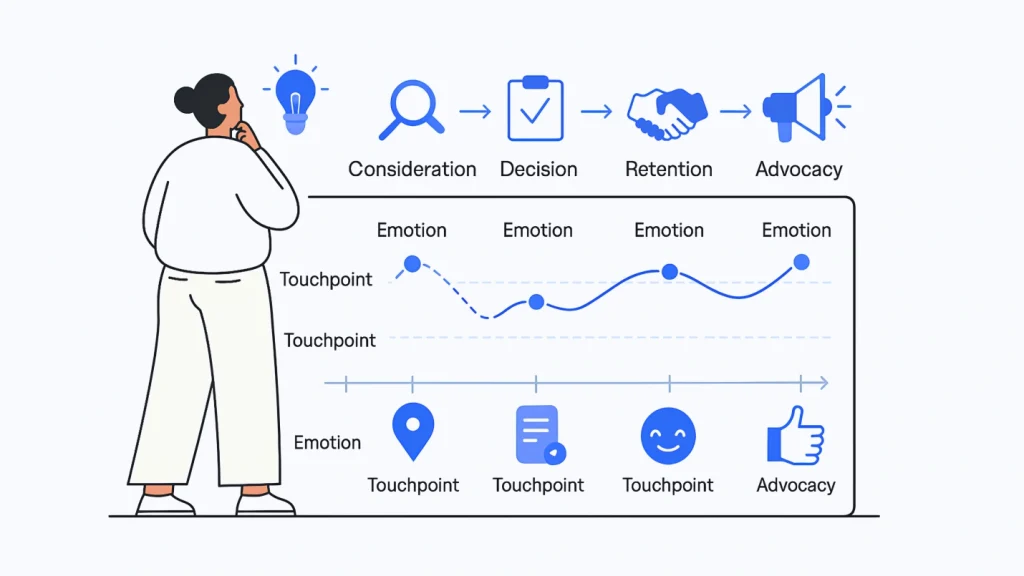
The missing piece is the decision happening underneath those actions.
That’s where the Mirror Decision System comes in.
Instead of asking, “What touchpoint does my customer need next?”, you ask:
“What does my buyer’s brain need to resolve before it can move to the next decision?”
That shift changes how you build your customer journey, your content, your sales process, and ultimately your marketing.
A customer journey map is a visual representation of the steps, interactions, and experiences a customer goes through when engaging with a business.
Traditionally, businesses map stages such as:
They then identify the touchpoints associated with each stage.
For example, a B2B customer journey map might include:
This can be useful.
But there’s a problem.
A list of touchpoints isn’t the same thing as a map of the decision.
Your customer isn’t moving through your marketing because they completed a predetermined checklist.
They’re moving because something in their mind has been resolved enough for them to take the next step.
And if that resolution doesn’t happen, they stall.
There are two common ways businesses build a customer journey map.
Someone who simply wants to lose weight now has to figure out:
They start with something like:
Awareness → Consideration → Decision
Then they attach marketing assets to each stage.
The problem is that this tells you what you’ve built—not necessarily what the buyer needs.
The second approach seems more sophisticated.
You survey customers.
You interview prospects.
You ask:
The answers can sound incredibly useful.
But there’s a fundamental limitation.
People don’t always have conscious access to the real sequence behind their decisions.
That doesn’t mean customers are lying.
It means their explanation may not reveal the actual decision process that caused the behavior.
So if you build your entire customer journey map around what people tell you they wanted, you may simply be building a map around the story they created after the decision.
You might decide to let your data build the customer journey for you.
You look at:
Again, this sounds incredibly data-driven.
But your analytics can only tell you which of the options you’ve already created performed best.
They can’t tell you about the thing you never created.
They can’t show you:
Your analytics can show you what people chose from the journey you created.
They don’t necessarily show you what the journey needed to contain.
Every time someone makes a decision, there are questions their brain needs to resolve.
The decision could be tiny:
“What should I eat for dinner?”
Or enormous:
“Should I invest $50,000 in this engagement?”
The complexity of the purchase may change.
The decision process underneath it doesn’t disappear.
The Mirror Decision System identifies five decision checkpoints that need to be resolved before someone can move forward.
These five checkpoints give you a fundamentally different way to approach customer journey mapping.
Instead of mapping only what your customer does, you map what your customer needs to know, believe, and resolve to continue.
The first question is:
“Why do I need to solve this now?”
This is the moment when someone recognizes that something has to change.
Not someday.
Not eventually.
Now.
This is why generic customer personas can be insufficient.
A persona might tell you:
“Our ideal customer is a business owner who wants to grow.”
But that doesn’t tell you what is happening in the customer’s life at the moment they become ready to act.
Compare that with:
“You’ve been passed up for the promotion three times, you’re working overtime, you’re taking on every extra project, and you still have nothing to show for it.”
That’s not merely describing a demographic.
It’s describing a moment of change.
It is knows as DNA messaging: speaking to the highest-intent buyer at the exact moment when they recognize the need to change.
Instead of asking:
“What content should we create for the awareness stage?”
Ask:
“What exact situation causes our highest-intent buyer to realize they need to act?”
Your marketing should make that person recognize themselves.
Because if they don’t recognize the problem as their current problem, there may be no reason for them to enter the journey at all.
Once someone decides they need to solve something, the next question becomes:
“What could solve this?”
This is where your buyer begins exploring solutions.
But there’s another mistake businesses make here.
They assume everyone wants the same outcome from the same solution.
They don’t.
Two people can buy the exact same service for completely different reasons.
One founder might want relief from the anxiety of constantly guessing what to do next.
Another might already have a successful business but want to become recognized as the category leader.
Same offer.
Different demand.
Different reason for buying.
If your messaging only speaks to one of those motivations, the other person may conclude:
“This isn’t for me.”
Even when your offer would have been exactly right.
The problem isn’t necessarily the offer.
The buyer never recognized their reason for wanting it inside your marketing.
This is where demand angles become important.
Your customer journey map shouldn’t only show that someone has entered the “consideration” stage.
It should identify the different desires that can cause someone to seek the solution in the first place.
Once buyers understand that a solution exists, they begin comparing.
This is where your competition enters the picture.
And “competition” doesn’t just mean another company.
Your buyer may compare you against:
Most businesses try to win this comparison by becoming the best option.
But being the best option doesn’t stop comparison.
If you’re one of five “best” options, you’re still one of five options.
The goal is to become the option where comparison stops making sense.
That’s where the transcript introduces the concept of an innovation asset.
Your offer is what someone gets.
Your innovation asset is the reason they believe your approach is fundamentally different from the alternatives.
It identifies the gap that other solutions leave open and gives the buyer a reason to stop comparing.
For example, saying:
“We’re really good at what we do.”
isn’t enough.
Everyone can say that.
An innovation asset instead answers:
“What specific gap does the entire category leave open that our approach uniquely closes?”
When that answer is clear, the buyer isn’t simply asking:
“Which provider is best?”
They’re asking:
“Why would I choose an alternative when this solves the problem in a way the others don’t?”
That is a much more powerful position to occupy.
This is one of the most important stages in the customer decision journey.
Because even if someone understands the problem…
And even if they want the solution…
And even if they’ve decided your approach is different…
They still have one question:
“Will this actually work for someone like me?”
Notice that this is different from asking whether your solution has worked for someone else.
That’s what a traditional testimonial usually proves:
“This worked for them.”
But your buyer needs to know:
“Why will this work in my situation?”
This is where results mechanisms come in.
Results mechanisms aren’t simply proof.
They’re the structural elements inside your delivery that make successful application more likely.
Now the buyer has made the decision.
They know:
Now they need one thing:
The next step.
They give the buyer:
It feels like you’re giving them choices.
But every choice is another decision.
And every additional decision creates another opportunity to stall.
The Mirror Decision System calls this a single-lane decision.
Instead of giving the buyer a maze of options, give them one obvious next move.
The goal is to preserve the momentum that already exists.
This is where the five-checkpoint model becomes much more useful than a traditional customer journey map.
When a checkpoint isn’t resolved, your buyer doesn’t simply sit there waiting for your marketing team to catch up.
Their brain takes a detour.
Maybe they:
And this explains something that drives many businesses crazy:
Your marketing can look healthy while your conversions remain disappointing.
You have traffic.
You have engagement.
You have people watching.
But something is missing between interest and commitment.
The buyer reaches a checkpoint.
There is no answer.
So they create their own answer.
And you don’t necessarily get to hear what that answer was.
This is where the Mirror Decision System becomes more than a customer journey map.
It gives you a way to diagnose the gap.
If buyers don’t recognize themselves…
Look at Checkpoint 1: Point of Need.
Your messaging may not be speaking to the buyer’s actual moment of change.
If buyers recognize the problem but don’t see themselves in your offer…
Look at Checkpoint 2: Looking for a Solution.
Your messaging may only be speaking to one demand angle.
Learn more about how to transform your podcast from a top-of-funnel attention-grabber into a middle-of-funnel nurturer that drives real results.
Check out our Bingeable, On- Demand System that shares exactly how The Netflix Effect gets your leads to sell themselves.