

If your business can’t grow without you, you don’t have a growth problem.
You have an architecture problem.
Many founders assume that scaling requires hiring more people, investing in better software, or launching more offers. Those tactics may increase revenue,
but they rarely create freedom.
Instead, they often create something worse:
A larger business that’s even more dependent on the founder.
The difference between an overworked founder and an Architect CEO
comes down to one thing:
Whether the business was designed to run without you—or whether you became the system it depends on.
In this article, we’ll explore:

Mom of 3. A Business Innovation Strategist that will journey with you to get your leads to sell themselves.
[01] Messaging
[02] Client Acquisition
[03] Innovation
[04] Thought Leader
[05] Sales Systems
Most successful businesses start the same way.
A client has a problem.
You solve it.
Something breaks.
You fix it.
Revenue slows.
You launch something new.
For years, this works.
The problem is that every solution requires you.
Eventually your business reaches a point where:
“The business grows, but only as fast as your calendar allows.”
Instead of leading the company…
You become its most valuable employee.
Imagine Sarah owns a successful consulting business.
She has:
On paper, she’s successful.
But every vacation gets interrupted.
Her team messages her constantly.
Clients refuse to move forward without her approval.
Marketing pauses whenever she isn’t available.
If Sarah disappears for 30 days…
Revenue slows almost immediately.
That isn’t a staffing problem.
It’s an architectural problem.
The internet loves one piece of advice:
“Just hire.”
But hiring rarely fixes poor business architecture.
Remember the founder making multiple millions in revenue who continued hiring people every time something broke?
She hired:
Every hire solved today’s pain.
None solved tomorrow’s.
Instead of becoming simpler…
The business became more expensive.
Imagine you have chronic back pain.
Every day you take painkillers.
The symptoms disappear.
But the injury remains.

Eventually:
Businesses work the same way.
Hiring without architecture is simply another painkiller.
Most companies try to become better.
The strongest companies become different.
Look at some of the biggest brands in the world.

Each individual decision makes sense.
Another offer.
Another funnel.
Another software.
Another employee.
Another marketing strategy.
Individually?
Perfectly reasonable.
Collectively?
A monster.
Every piece has a purpose, but without a central design, the business only works while the founder keeps all the parts together.
When you’re motivated…
Everything improves.
When you’re exhausted…
Everything slows down.
Your energy determines company performance.
That’s not leadership.
That’s dependency.
Examples include:
Complexity grows faster than freedom.
Many founders have:
More isn’t the answer.
Activation is.
One month:
Referrals.
Next month:
A podcast interview.
Next month:
A post from two years ago.
If you don’t know exactly where predictable revenue comes from…
You don’t have a scalable system.
Facebook once operated under the famous motto:
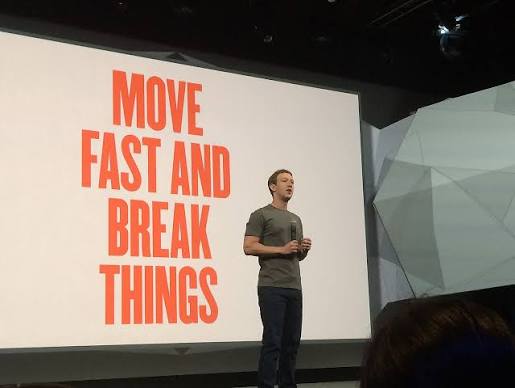
It helped them scale rapidly.
Until it didn’t.
As Facebook grew, reactive decision-making produced:
Eventually they changed their philosophy to:
“Move fast with stable infrastructure.
Even billion-dollar companies eventually discover:
Speed without architecture creates instability.
Instead of adding more pieces…
Architect CEOs build systems
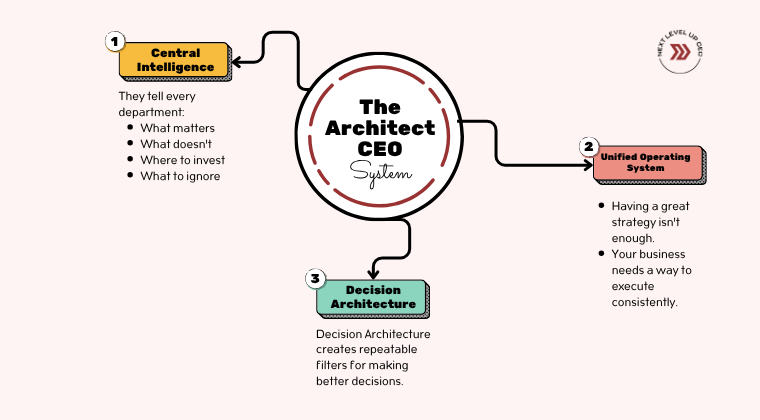
Every successful company has one governing idea.
Netflix asks:
Will this keep people watching?
Apple asks:
Does this make technology more human?
Nike operates around:
Just Do It.
These aren’t marketing slogans.
They’re decision filters.
They tell every department:
Example:
Without Central Intelligence:
Marketing promotes one thing.
Sales promises another.
Delivery evolves independently.
Everyone works hard…
But not together.
With Central Intelligence:
Every department reinforces the same strategy.
Having a great strategy isn’t enough.
Your business needs a way to execute consistently.
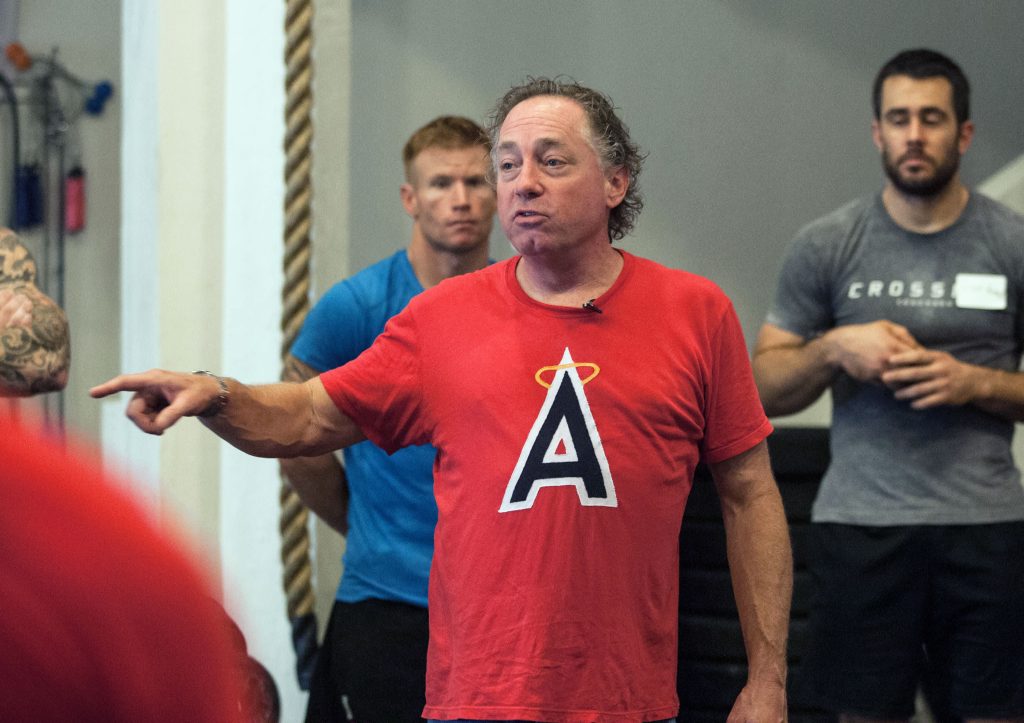
Greg Glassman didn’t simply invent workouts.
He created:
Today, thousands of CrossFit gyms deliver the same experience without Glassman being present.
The operating system—not the founder—creates consistency.
OTHER GREAT EXAMPLES:
That’s what scalable systems look like.
Many founders rebuild instead of optimize.
Every webinar changes.
Every offer changes.
Every campaign starts from scratch.
Decision Architecture creates repeatable filters for making better decisions.
Instead of debating everything equally…
Leaders know what deserves careful thinking and what deserves speed.
REAL EXAMPLE:
One founder was running:
After implementing decision architecture:
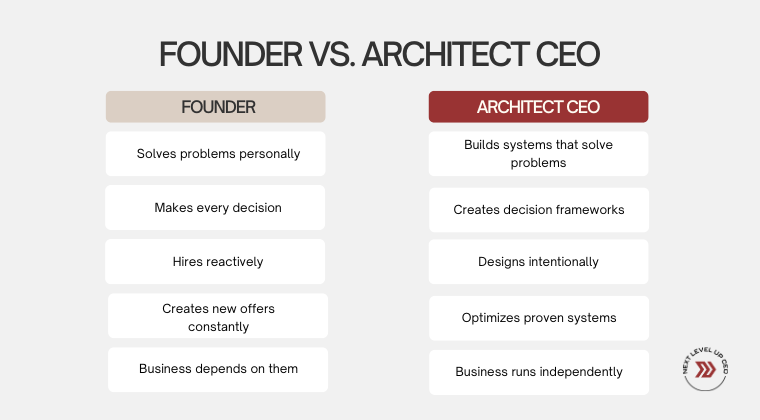
Most founders don’t become trapped because they lack ambition.
They become trapped because they accidentally become the operating system.
The more successful they become…
The more the business depends on them.
Real scale doesn’t come from adding more people, more software, or more offers.
It comes from replacing founder dependency with intentional business architecture.
When you build:
Your company begins creating growth without demanding more of your time.
That’s the shift from being the most overworked employee…
To becoming the Architect CEO.
Learn more about how to transform your podcast from a top-of-funnel attention-grabber into a middle-of-funnel nurturer that drives real results.
Check out our Bingeable, On- Demand System that shares exactly how The Netflix Effect gets your leads to sell themselves.