
You’re posting consistently.
Your content is insightful.
People tell you:
And yet…
They disappear the moment you mention your offer.
That’s the frustrating part.
Because your expertise is real.
Your content is working.
It’s just not converting into premium clients.
And according to the transcript, the issue is not your hooks, your consistency, or your algorithm strategy.
It’s something much deeper:

Mom of 3. A Business Innovation Strategist that will journey with you to get your leads to sell themselves.
[01] Messaging
[02] Client Acquisition
[03] Innovation
[04] Thought Leader
[05] Sales Systems
Most experts create content from expertise.
But buyers search from desire.
Those are not the same thing.
“Your buyers aren’t searching for what you know is important. They’re searching for what they think they need.”
That one line explains why so many experts struggle.
Because experts naturally speak from:
But buyers are searching from:
The more experienced you become, the harder it is to remember what it felt like before you knew what you know now.
So what happens?
You start speaking:
Meanwhile your buyers are still typing things into Google like:
That disconnect is deadly.
“The space between what your buyer actually needs to hear and what everyone in your market is saying.”
And this is where most content dies.
Not because it’s bad.
Because it’s disconnected.
Most marketing advice focuses on delivery:
“You can have the best delivery in the world, and if your message wasn’t built on the right intelligence, you’re just delivering the wrong thing faster, louder, and more consistently.”
That changes the conversation completely.
Because the issue isn’t performance.
It’s foundation.
One of the strongest sections in the transcript compares content creation to brands like Netflix and Spotify.
These brands don’t create based on assumptions.
They create based on:
High-converting content is built from two types of intelligence:
Together, they create what the speaker calls:
Market intelligence helps you understand:
This is what makes content feel instantly relevant.
At first, they marketed it as:
Logical, right?
But sales tanked.
So P&G researchers went into people’s homes to observe behavior directly.
And they discovered something surprising:

People living with bad smells had become:
They literally couldn’t smell the odor anymore.
So messaging about “eliminating odors” meant nothing.
Because buyers didn’t believe they had that problem.
Researchers noticed something else.
At the end of cleaning, people had a ritual:
That final step made the room feel complete.
So Febreze repositioned itself.
Not as an odor remover.
But as:
And sales doubled within two months.
The product didn’t change.
The intelligence changed.
Most experts talk about:
But buyers care first about:
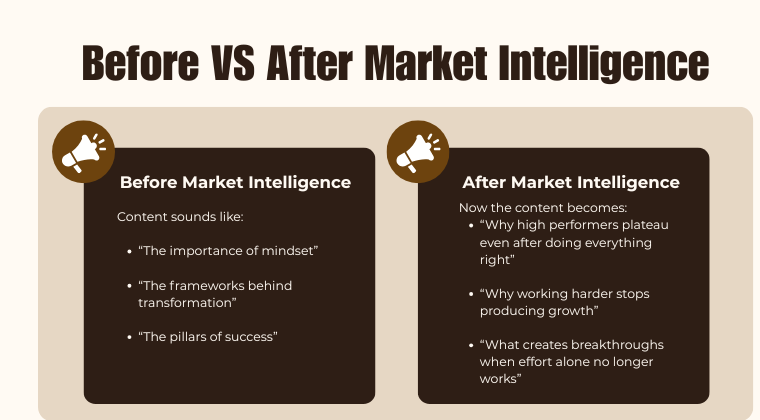
Even relevant content can fail if it sounds like everyone else.
When Red Bull entered the market, sports drinks already existed.
Brands like:
Were all talking about:
So Red Bull didn’t try to become:
Instead, they found the gap.

Nobody was talking about:
So Red Bull built its positioning there.
And instead of competing inside the existing category…
They created a different conversation.
That’s competitive intelligence.
Your buyers are consuming:
So if your content says the same thing everyone else says…
Your buyer mentally files you into the same category.
Even if your expertise is better.
When everyone in a market repeats the same language, the same promises, and the same positioning, buyers stop noticing it.
The market becomes numb.
That’s why generic content disappears.
The opportunity is not where everyone is speaking.
It’s where nobody is speaking yet.
“That absence is your positioning.”
That’s the breakthrough.
“If your ideal client typed their problem into Google, would your content show up as the answer?”
Or would it sound adjacent to the problem?
That distinction matters.
“Could your buyer swap out your name for your competitor’s and not notice the difference?”
If yes…
Your content lacks competitive intelligence.
One of the strongest ideas in the transcript is this:
You should not interrupt the buyer’s thought process.
You should mirror it.
Instead of:
Trying to educate endlessly…
You structure the journey around what they are already thinking.
So every touchpoint feels like:
“Yes. Exactly.”
Content does not convert because it’s good.
It converts because it’s built on intelligence.
The brands winning today are not louder.
They are more precise.
They understand:
And once your content is built on that foundation.
It stops sounding like content.
And starts sounding like:
Learn more about how to transform your podcast from a top-of-funnel attention-grabber into a middle-of-funnel nurturer that drives real results.
Check out our Bingeable, On- Demand System that shares exactly how The Netflix Effect gets your leads to sell themselves.
