

For 77 consecutive years, GM was the most powerful company in the world.
Then one recession exposed the only thing revenue can never fix:
“A business that can only survive when everything goes right.”

Mom of 3. A Business Innovation Strategist that will journey with you to get your leads to sell themselves.
[01] Messaging
[02] Client Acquisition
[03] Innovation
[04] Thought Leader
[05] Sales Systems
In 2024, we watched it happen again.
Thousands of businesses had:
And yet they couldn’t survive a slow month.
Not a crisis.
Not a collapse.
A slow month.
Because it was never the month that killed them.
It was what the month exposed.
This is the difference between a load-bearing business and a high profit architecture — and if you don’t understand it, revenue will only make your problem more expensive.
A load-bearing business is one that requires:
The team
The overhead
The ad spend
The founder’s constant involvement
Everything running perfectly
Just to stay alive.
It looks successful from the outside.
Full calendar.
Big months.
Growing team.
But behind the scenes?
It’s heavy.
And every time it grows, it gets heavier.
Most founders scale like this:
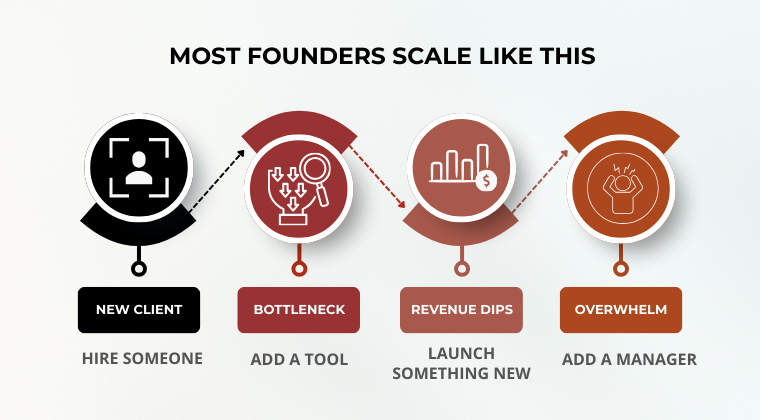
Every decision makes sense in the moment.
But every addition without architecture creates what’s called structural debt.
It doesn’t feel like debt.
It feels like progress.
Until the bill comes due.

Here’s how you build your own internal engine for innovation:
Remember when streaming replaced cable?
We thought:
“No more paying for 300 channels I don’t watch.”
So we added:
Netflix
Hulu
HBO
Disney+
Apple TV
Each one made sense.
Until the bill arrived — and it was higher than cable.
Not because streaming was bad.
But because we stacked options without building a system.
That’s what most founders do in business.
They don’t build.
They stack.
A load-bearing business doesn’t announce itself.
It reveals itself.
Revenue doesn’t fix a load-bearing business.
It makes it more expensive to maintain.
You can walk into a McDonald’s in:
Once you integrate these three, your business stops being heavy—it starts compounding. Your decisions stop being guesses—they become judgment.
Akron, Ohio
Tokyo, Japan
And get the same experience.
That’s not talent.
That’s the Speedee Service System.

Ray Kroc didn’t build restaurants.
He built operating systems.
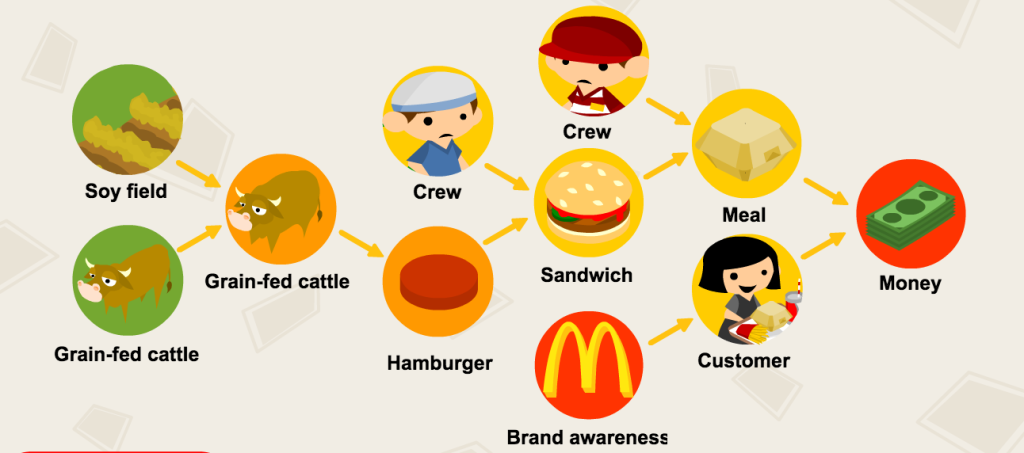
A first-day employee can run a station effectively not because they’re gifted — but because the system tells them:
The quality isn’t dependent on the chef.
The business doesn’t require Ray Kroc in the building.
That’s architecture.
In the 70s and 80s, GM, Ford, and Chrysler looked untouchable.
They were bigger than Toyota.
More factories.
More workers.
More revenue.
But they were bloated by design.
Growth required more input every time.
Toyota built something different:
An operating system that refused to carry weight it hadn’t earned.
So when the market slowed:
Their cost structure flexed.
Their system didn’t panic.
They didn’t need a bailout.
That wasn’t luck.
It was architecture.
A high profit business is built on three structural components.
This is not your offer.
It’s the mechanism that makes your offer work.
It’s:
Most founders build this for marketing.
High profit founders install it operationally.
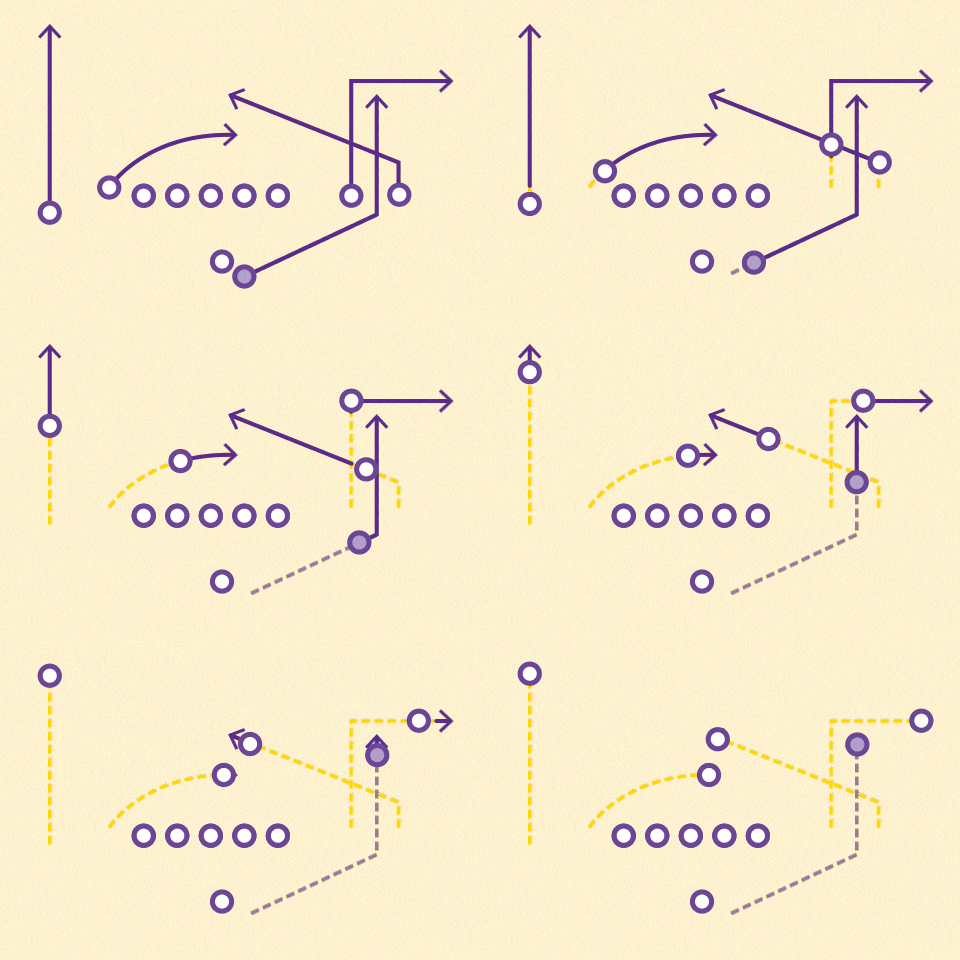
Think of an NFL team.
The coach doesn’t run every play.
He builds a playbook.
If a new player joins, they don’t shadow the coach.
They learn the system.
Now test your business:
If you ask your team:
“How do we create results?”
Do they answer differently?
If yes — you don’t have a core installed.
If they answer the same — you have architecture.
Most businesses have:
Marketing doing its thing
Sales doing its thing
Delivery improvising
Operations patching holes
That’s fragmentation.
In a high profit model, you have five core systems:
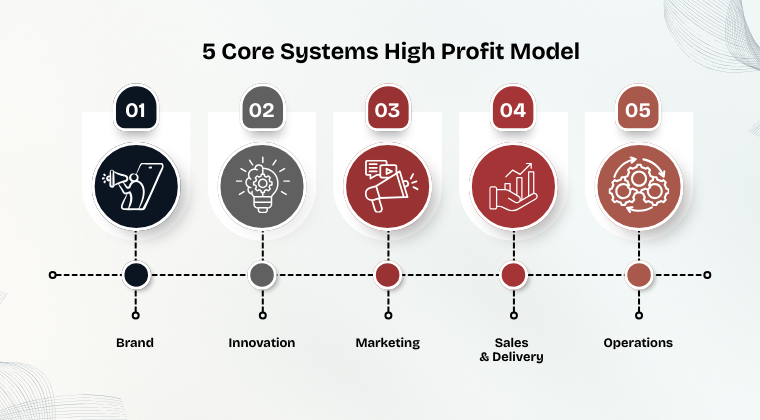
And they are all expressions of one central asset.
Eight rowers.
If they pull at different rhythms, the boat wobbles.
Same athletes.
Same oars.
But when synchronized?
The boat moves faster with less effort.
High profit businesses don’t work harder.
They work together.

Most founders hire to fill gaps:
“I don’t want to run ads.”
“I need someone to manage clients.”
“I need someone to handle data.”
So they hire.
Now that person becomes a single point of failure.
Lose your head of sales?
Pipeline stalls.
Lose your ops manager?
Backend wobbles.
That’s fragility.
In a high profit business:
People don’t generate power.
They channel it.
The grid generates power.
Appliances plug in.
Remove one appliance?
The grid keeps running.
Add ten more?
The grid doesn’t strain.
Your innovation asset is the grid.
Your team are the appliances.
If your best team member left tomorrow — would the system survive?
That’s the real test.
One client came in running a seven-figure business.
Public figure.
Book published.
Thousands of clients.
Behind the scenes?
15 team members
Tens of thousands in ad spend
Constant launching
Drained bank account
No time with her kids
It wasn’t a revenue issue.
It was structural debt.
Cut $31,000 in expenses
Reduced bloated team
Halved ad spend
Immediate breathing room.
Built five core systems around her innovation asset.
Focused on three offers instead of seven.
Pulled ads in-house with a VA.
Four months later:
Tripled profit
Three-week vacation to Europe
Afternoons with her kids
No operational crisis
Not because she worked harder.
Because she replaced load-bearing structure with architecture.
A load-bearing business:
Gets heavier every time it grows.
Requires more input for more output.
Depends on everything going right.
A high profit business:
The difference isn’t effort.
It’s design.
Once the high profit foundation is built, you layer in:
Innovation asset (win the market)
Bingeable decision system (convert the market)
Happy client machine (compound the market)
But none of that works without structure.
Because the businesses that survive are not the ones with the most revenue.
They’re the ones built to hold it.
Right now, your business is on one of two roads:
Every year gets heavier.
Every year gets stronger.
If growth costs you more time, more stress, more input —
You’re load-bearing.
If growth strengthens the system and increases margin —
You’re architectural.
Revenue can hide fragility.
Architecture removes it.
And only one of those scales without costing you your life.
Learn more about how to transform your podcast from a top-of-funnel attention-grabber into a middle-of-funnel nurturer that drives real results.
Check out our Bingeable, On- Demand System that shares exactly how The Netflix Effect gets your leads to sell themselves.